KL Publishing Group proudly announces the release of Virtuoso Bass, Issue 4: “The Founding Four,” a landmark edition devoted to documenting and canonizing the architects of jazz fusion bass while preserving one of the most influential musical movements of the modern era.
(PRUnderground) May 11th, 2026
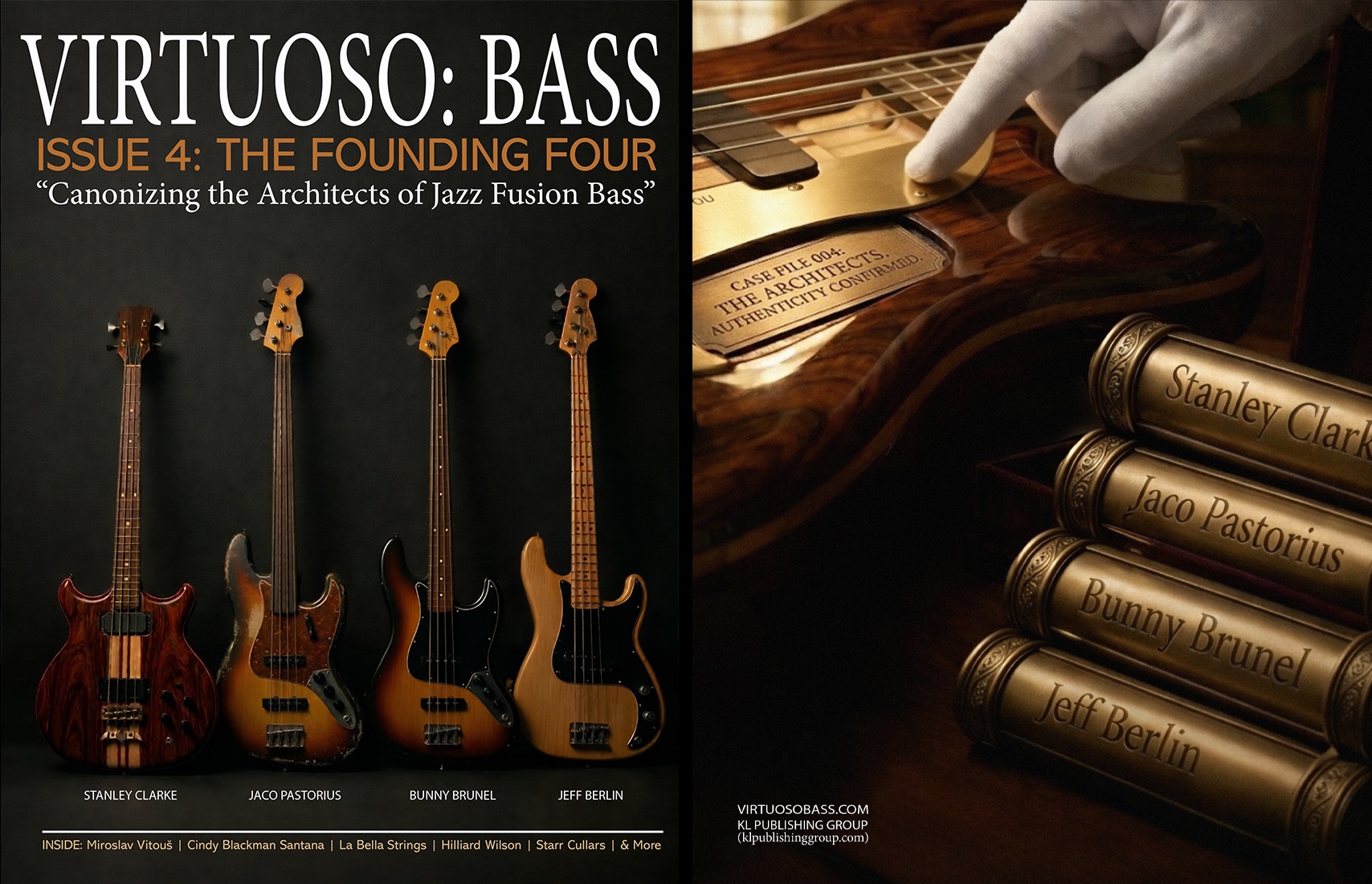
More than a magazine issue, Virtuoso Bass, Issue 4: “The Founding Four” represents the beginning of a larger archival initiative dedicated to documenting the lineage of fusion bass before its history is diluted, rewritten, or forgotten. The issue formally identifies Stanley Clarke, Jaco Pastorius, Bunny Brunel, and Jeff Berlin as “The Founding Four” of jazz fusion bass; musicians whose innovations permanently transformed the role of the electric bass from supporting instrument into a melodic, harmonic, and compositional voice at the forefront of modern music. These four musicians are not presented as competitors, but as four pillars of the same historical argument; artists whose innovations collectively reshaped the language of modern fusion bass. The sequence presented in the canon framework also reflects historical chronology and firsthand perspective from musicians directly connected to fusion’s formative era.
The canon research presented in the issue draws upon historical recordings, documented musical lineage, educational influence, and testimony from musicians directly connected to the formative years of fusion itself. The forthcoming Virtuoso Bass canon volume expands further on that chronology, including historical clarification and perspective provided by legendary keyboardist Patrick Moraz, whose firsthand experiences during fusion’s formative era helped establish the sequence and interconnected development of the movement’s foundational bass architects. According to the editorial research presented throughout the issue and the forthcoming hardcover volume, the canon was not determined through popularity or commercial success alone, but through chronology, innovation, harmonic advancement, educational impact, and the documented expansion of the bass into a frontline compositional instrument.
“There is a moment in every art form when the language stops being experimental and becomes inevitable,” writes the magazine’s Executive Editor in the issue’s centerpiece feature, The Founding Four: Canonizing the Architects of Jazz Fusion Bass. “For jazz fusion bass, that moment arrived when four players stepped forward and refused to treat the instrument as background furniture.”
The feature examines the historical emergence of the fusion bass movement through recordings, interviews, educational influence, and technical innovation, while making the case that the language of modern fusion bass rests on the shoulders of these four architects. “This article exists to draw the line in ink, not in pencil,” the article declares.
The issue’s cover itself serves as a visual extension of that historical thesis, featuring the foundational instruments associated with each of the four pioneers during the formative years of jazz fusion . . . basses that helped shape the sound, vocabulary, and identity of the movement itself.
The issue also examines the actual instruments behind the movement in a detailed feature titled “The Founding Four (1978: The Peak of the Architects),” tracing the forensic history and modifications behind the basses that helped redefine fusion music. Among the standout revelations: Stanley Clarke’s 1973 Alembic Series I is described as “the first boutique active bass to define fusion,” while the article recounts the moment Alembic’s Ron Wickersham reportedly watched Clarke test the instrument and declared, “We just found out what this thing is for.” The feature also explores how Jaco Pastorius personally transformed his 1962 Fender Jazz Bass into the legendary “Bass of Doom,” noting, “Jaco didn’t buy a fretless; he created it.” Meanwhile, Bunny Brunel’s modified 1965 fretless Precision Bass and Jeff Berlin’s famously stripped-down 1976 Precision Bass illustrate the radically different philosophies that collectively shaped the language of modern fusion bass.
Bunny Brunel, widely regarded as one of fusion bass’s pioneering voices, speaks candidly throughout the issue about the development of the genre, harmonic language, and the importance of preserving the historical record. “Fusion didn’t drop out of the sky, and it didn’t assemble itself from random musicians,” Brunel states in his featured interview. “It was built. And the bass didn’t accidentally end up in the front. It earned that spot.”
Highlights from the issue include a major historical retrospective on Miroslav Vitouš; an extensive feature on Cindy Blackman Santana and the legacy of Tony Williams; The Art of Tension, exploring La Bella Strings and modern bass tone; fusion album retrospectives revisiting landmark recordings by Frank Zappa, Larry Coryell, and Allan Holdsworth; an in-depth interview with bassist Starr Cullars; a spotlight feature on veteran bassist/composer Hilliard Wilson; and The Canon Part 2: The Workbench, examining the luthiers and builders behind the movement’s most influential instruments. The release also coincides with the launch of the newly redesigned official website of Bunny Brunel at Bunny Brunel Official.
According to the magazine’s foreword, the issue also serves as a preview of the forthcoming Virtuoso Bass canon hardcover volume currently in development through KL Publishing Group, a comprehensive historical study documenting the evolution of modern bass playing and the musicians who shaped it. The forthcoming hardcover volume will also feature a foreword by legendary keyboardist, composer, and Earth, Wind & Fire founding member Larry Dunn, further underscoring the project’s connection to the musicians and innovators who shaped fusion’s formative era.
The Miroslav Vitouš feature observes, “Fusion was the last form of popular music that demanded the full arsenal of musicianship; instrumental technique, harmonic fluency, rhythmic literacy, improvisational language, compositional architecture, ensemble communication, and stage authority.”
Why These Four
So why call this canon in a magazine that lives inside the community it is describing? Because at some point, history has to be written from the inside.
Stanley Clarke established, on a global stage, that the electric bass could lead a band in jazz fusion without apology. Jaco Pastorius took the fretless bass and turned it into a melodic, harmonic, and emotional voice that still defines the instrument. Jeff Berlin brought an uncompromising standard of time, tone, and harmonic fluency that continues to set the bar for serious players and students. Bunny Brunel bridged continents, anchored historic projects, and built an educational architecture that allows players to study fusion bass as a complete language rather than a collection of licks.
Together, they opened up the harmonic spaces that fusion needed. They demonstrated that bassists could be composers, leaders, and authors of method books. They proved that the instrument could handle dense harmony, odd meters, and blistering tempos without losing its fundamental responsibility to the groove.
This issue of Virtuoso Bass is not about nostalgia. It is about continuity. The Founding Four are not museum pieces. Their ideas are alive in every young player who picks up a bass, plugs into an amp, and expects to be heard as a complete musician.
We are simply doing what serious magazines are supposed to do. We are naming the architects.
Virtuoso Bass extends special thanks to KL Publishing Group’s research team, editorial contributors, writers, photographers, historians, and contributing staff for their role in helping document and preserve the historical framework presented in Virtuoso Bass, Issue 4: “The Founding Four.” The magazine also recognizes the participation of its contributing journalists, media correspondents, and editorial collaborators whose collective efforts helped shape this landmark canon edition. Virtuoso Bass is sponsored by La Bella Strings.
Virtuoso Bass, Issue 4: “The Founding Four” is now available through Amazon in 12 countries and through select retailers worldwide. For more information, visit:
Media Contact:
Virtuoso Bass, Issue 4: “The Founding Four” cover and editorial materials available upon request.
About Virtuoso Bass
VIRTUOSO BASS Magazine, considered the premier lifestyle magazine for elite bass players, is the ultimate destination for bass enthusiasts, featuring in-depth interviews, captivating profiles, and insightful commentary on the world of bass, Jazz, and fusion. Each issue showcases legendary bassists, rising stars, and iconic albums, providing readers with a comprehensive look into the rich landscape of bass music. With a commitment to excellence and a passion for the art of bass, VIRTUOSO BASS continues to inspire and educate bass players around the globe.
The post Virtuoso Bass, Issue 4: “The Founding Four” Establishes the Canon of Jazz Fusion Bass first appeared on
Original Press Release.