Auburn's College of Education embraces an AI-powered future to advance its mission
PR Newswire
AUBURN, Ala., April 22, 2026
AUBURN, Ala., April 22, 2026 /PRNewswire/ -- As Artificial Intelligence (AI) becomes more integrated into daily life, Auburn University's College of Education is sharpening its focus on this powerful tool and exploring how it can strengthen the preparation of future educators and healthcare workers.
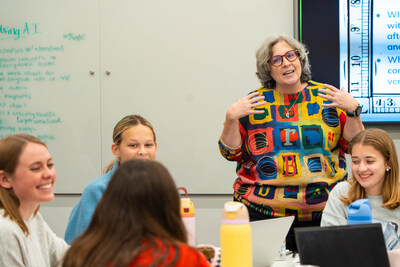
Throughout the College of Education (and featured in the recent release of the college's Keystone Magazine), artificial intelligence is being thoughtfully integrated across its four academic units, reflecting both the breadth of the college and a shared commitment to ethical, human-centered practice. Auburn College of Education Dean Jeffrey Fairbrother shared his perspective on how artificial intelligence aligns with the college's vision for the future.
"In the College of Education, we're committed to opening doors and improving lives, and artificial intelligence is an important door to opportunity," he said. "I am proud of our faculty who are embracing AI to expand access, enhance learning and empower educators, always guided by ethics and integrity. By opening these doors today, we're building a better future for all, far into the future."
In the Department of Curriculum and Teaching, faculty are focused on teacher preparation and continuously improving methods of learning. Paul Fitchett, head of C&T, oversees several faculty members leading AI-focused initiatives, including some who are developing a course on the applied use of AI in the workplace that will come with industry credentialing.
"We are exploring AI through a number of different, applied facets," Fitchett said. "Some individuals are leveraging AI to expand research capabilities while others are engaging AI to support teaching and learning, improving the educational experience for instructors and students alike."
In Agricultural Education, Leadership and Communications, AI is treated as both a research tool and an object of study, with faculty developing a new AI course and even patent-pending technologies that support agriculture, Extension work and global food systems, always emphasizing the "expert in the loop" and transparency over blind automation. In Elementary Education, future teachers learn to use AI as a collaborative planning and efficiency tool, refining outputs through pedagogical expertise and deep knowledge of learners.
Margaret Flores, interim head of the Department of Special Education, Rehabilitation, and Counseling, emphasized the importance of research regarding how AI will impact these professions. SERC faculty members are working to integrate AI into their classrooms to inform their students about future uses in their careers.
In Clinical Rehabilitation Counseling, faculty are embedding AI directly into applied coursework, training students to critically evaluate AI-generated vocational data, labor market information and assessment recommendations while grounding decisions in professional judgment and ethics. In the School Counseling Program, students are prepared to navigate AI's possibilities and limits through ethics-focused coursework and national research, reinforcing that empathy, nuance and confidentiality remain irreplaceable.
Meanwhile, the Education to Accomplish Growth in Life Experiences for Success (EAGLES) Program is leveraging AI as an equalizer for students with intellectual disabilities, using federally funded digital literacy and AI modules to promote independence, self-advocacy and access.
"AI can enhance the services or instruction that we provide, reduce administrative tasks and increase efficiency in research," Flores said. "We must ensure that researchers are shaping how AI is changing our fields."
In the Department of Educational Foundations, Leadership, and Technology, faculty are working with AI in multiple ways. Through basic and applied research, faculty are addressing early childhood vocabulary learning and mathematics learning, and learning how AI can help with research workflow, STEM learning and even the development of education policy.
Several faculty members are also incorporating AI into their classrooms, including the use of an AU tutor to support independent learning and AI-explicit language in teaching materials such as syllabi.
EFLT Department Head Hank Murrah said that his unit's approach is about embracing the changes that come with AI while also working to shape how it will affect the future of education.
"We view AI as both a transformative research tool and a catalyst for innovation in teaching and learning," Murrah said. "Our faculty are developing AI-driven interventions for STEM education, leveraging AI to streamline research workflows and exploring ethical frameworks for its use in classrooms. These efforts position us to prepare graduates who are not only AI-literate but capable of shaping evidence-based policy and practice. We believe AI will redefine how educators design learning experiences and how researchers generate insights—making education more adaptive, fair and impactful."
Matt Miller serves as the director of the School of Kinesiology, whose faculty members are exploring how AI can help with conducting research and processing data to find ways to improve a person's health. Within the School of Kinesiology, AI is being introduced in coursework related to exercise prescription and programming, helping students analyze data, tailor training plans and think critically about how emerging technologies can support safe, individualized, evidence-based practice.
"School of Kinesiology faculty members conduct research that yields large and complex datasets involving measures related to human movement, including but not limited to their physical activity throughout the day, brain activity during exercise, joint angles while walking or throwing a ball and protein expression after exercise training," Miller said. "AI helps faculty members make sense of these measures to translate research findings into practical knowledge that can be used to enhance health and performance."
Additionally, in the School of Kinesiology, the Sensorimotor and Rehabilitation (SMART) Neuroscience Lab studies the neuroscience of human movement using virtual and augmented reality simulations. And now, a new member of the lab has joined the team to help understand things like balance and walking: Circuit, the robotic "dog" who comes complete with artificial intelligence built in. Circuit is what's called a quadruped robot ("robot dog"), and he's used to explore new ways of supporting older adults' safety at home.
Led by Director of Physical Therapy Harsimran Baweja, the SMART Neuroscience Lab is using Circuit to study whether robot dogs equipped with artificial intelligence and advanced sensors can reliably track human movement during everyday activities.
While there are many uses for AI, College of Education faculty members are also acutely aware that the human touch is an essential part of their work. The overall goal is to use AI to enhance the service provided to another human being, whether they are a student or a patient.
"Whatever their approach, integrity and professional ethics remain the driving force for our use of generative Artificial Intelligence," Fitchett said. "Maintaining these principles is essential as we navigate an ever-changing landscape."
Together, these efforts highlight a college-wide approach to AI that spans disciplines and populations, using emerging technologies not as replacements for human expertise, but as tools to expand opportunity, insight and impact.

 View original content to download multimedia:https://www.prnewswire.com/news-releases/auburns-college-of-education-embraces-an-ai-powered-future-to-advance-its-mission-302750731.html
SOURCE Auburn University College of Education